From Nebraska to the World: A New Chapter in Global Health Preparedness
Discover how Carecubes is transforming public health readiness through cost-effective mobile containment.

At the University of Nebraska Medical Center (UNMC), we often reflect on our responsibility not just to train the next generation of health professionals, but to strengthen the systems that protect lives.
At UNMC, that responsibility doesn’t end at the edge of our campus or even our state. It extends to the frontlines of every outbreak, every rural hospital, and every community vulnerable to the threats of infectious disease.
Today, with the public launch of Carecubes and the announcement of its Series A funding, we’re proud to see one of UNMC’s most important innovations go global. Carecubes is more than a product—it’s a symbol of how institutions like ours can lead with purpose, science, and service.
Why This Work Matters Now More Than Ever
Throughout history, microbes have claimed more lives than armed conflict. The COVID-19 pandemic made this threat painfully clear, taking more than a million lives in the U.S. alone. Yet even before COVID, UNMC had earned a national reputation as a leader in pandemic preparedness and infectious disease response.
In 2014, we were one of only three institutions nationwide equipped to care for Ebola patients. That didn’t happen by accident. It was the result of more than a decade of investment in biocontainment, training, research, and readiness. We had already built the state-of-the-art Nebraska Biocontainment Unit in conjunction with Nebraska Medicine, our major clinical partner. We had already drilled on protocols. We had already created a team that knew how to respond. When the moment came, we were ready.
When COVID emerged, we once again played a critical role, receiving the first confirmed U.S. patients from the Diamond Princess cruise ship, and standing up the only federally-funded National Quarantine Unit in the country right here at UNMC.
The Nebraska Model
That track record is what has become known nationally as the “Nebraska model”: a commitment to being ready before the crisis hits, and a deep belief in partnerships across sectors, disciplines, and borders. Through our Global Center for Health Security, we collaborate with the CDC, HHS, and the U.S. military. We train with rural hospitals and international ministries of health. And we approach every threat—be it Ebola, measles, or the next unknown pathogen—with humility, discipline, and science.
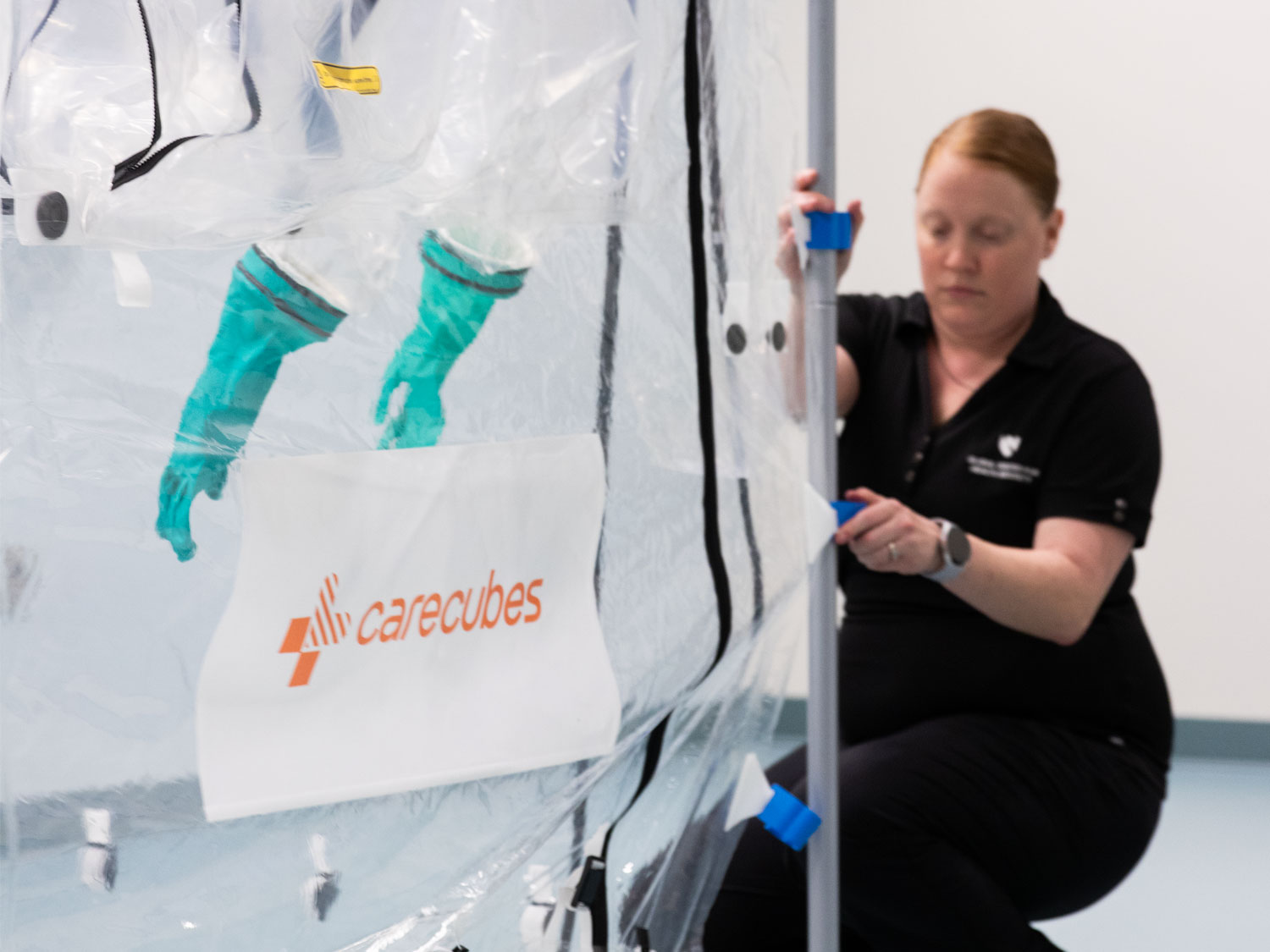
It was this spirit that led us to help develop the Carecube: a portable, negative pressure isolation unit that flips the traditional model of infectious disease care. Rather than wrapping the provider in layers of personal protective equipment (PPE), Carecube isolates the patient—creating a safe, HEPA-filtered environment where care can be delivered more quickly, more safely, and with fewer barriers.
Innovation Rooted in Real-World Needs
Carecube wasn’t built in a vacuum. It was built in partnership with hospitals in rural Nebraska, field teams in Africa, and frontline healthcare providers around the world. I’ve personally traveled with this device overseas and seen the way people respond. They immediately understood how transformative it can be. From questions about heat in hot climates to storage, transport, and cost—Carecubes listened, iterated, and improved.
Now, with this Series A investment, Carecubes can scale. Carecubes can help save lives not only in major medical centers, but in critical access hospitals, refugee camps, and mobile clinics. Carecubes can help prevent small outbreaks from becoming large ones. And Carecubes can protect the very people we rely on to protect us: our nurses, our doctors, our public health workers.
In a world where pathogens can cross borders in hours, preparedness is not a luxury. It’s a necessity.