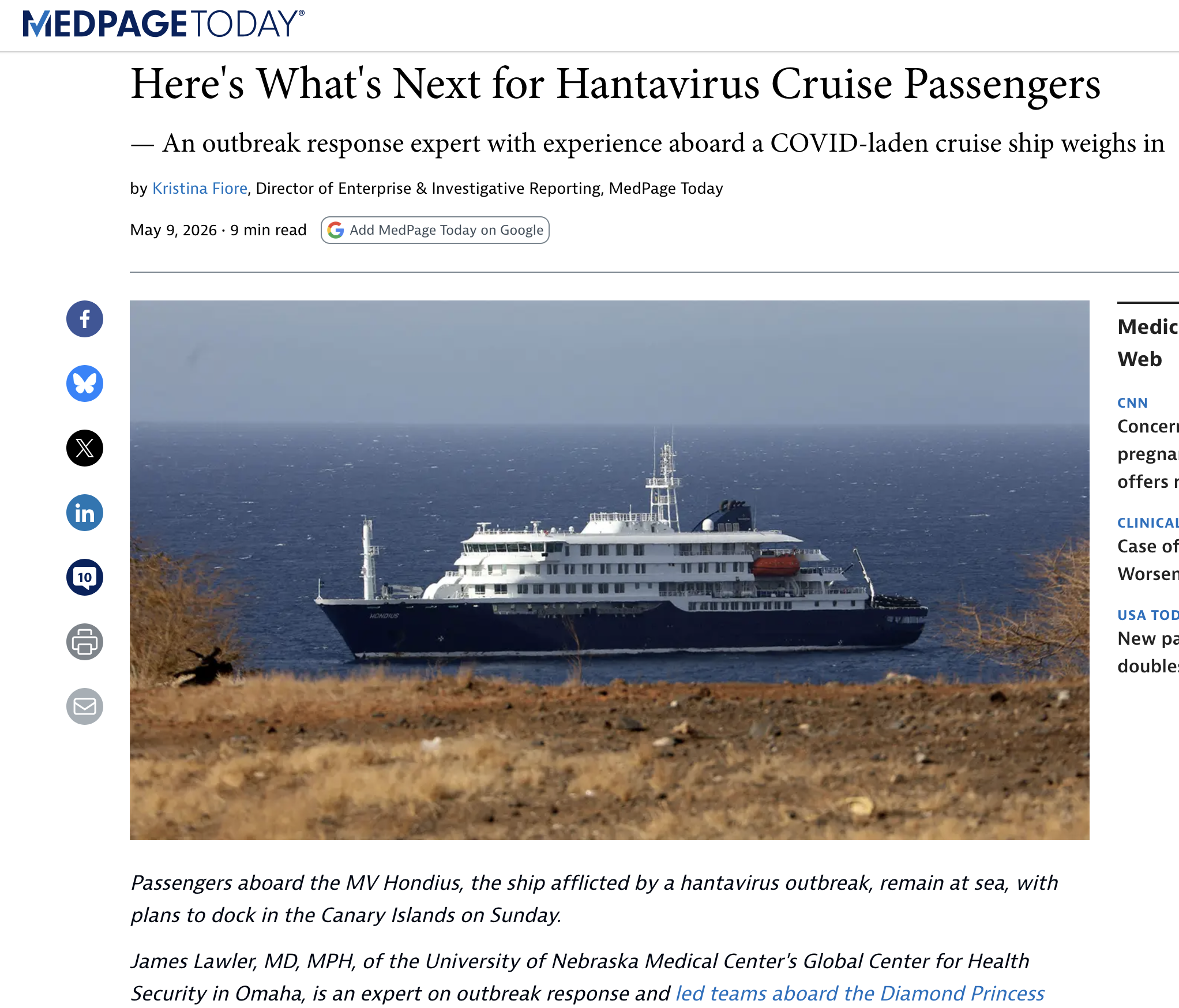
Editor’s Note: The following is an excerpt from MedPage Today, which recently interviewed Carecubes Advisor, and Co-Director of UNMC’s Global Center For Health Security, Dr. James Lawler, MD, MPH. He spoke with them about the recent hantavirus outbreak aboard a cruise ship and what those affected persons are going through.
He also discussed the genesis of the Carecube and how it can be used to improve U.S. capacity for managing high-consequence infectious disease patients.
Click here to read the full story.
MedPage Today: Why does it usually take so long for ships to dock when there’s an infectious disease on board?
Lawler: Unfortunately it’s a common occurrence when we have outbreaks of high-consequence infectious diseases. There’s obviously a huge fear factor among the general population and then politicians and policymakers often respond to those pressures and … many times end up making what are maybe not the best decisions, certainly in the interest of controlling the outbreak or in caring for the people who are affected.
That often works against the public health workers and healthcare workers trying to manage cases, trying to contain the outbreak. Delaying the ship’s docking until Sunday not only means we won’t be able to take people off of the ship until then if something happens, but it also means that responders and epidemiologists won’t have access to the ship, which is going to be an important part of doing a full investigation.
Passengers who are currently symptomatic were evacuated, but if more people develop symptoms — and this is a disease where you can decompensate pretty quickly — not being able to get them critical care until Sunday seems like a big deal.
Lawler: It does. It is a little bit more of a difficult disease to manage in that sense because the incubation period is so long, 6 or 7 weeks in some cases, and because people do tend to decompensate quickly once they start going down that path.
Usually there are several days of prodromal illness where you don’t have a lot of lung or respiratory involvement. But when the phase of disease hits where you start to get dysfunction of the cardiopulmonary system and people start experiencing shortness of breath or cough, in many cases those folks can decompensate within 24 hours, and that means that they may go from being OK, sitting around on room air, to being on a ventilator with a breathing tube down their throat.
…
MedPage Today: You’re involved with a project that aims to improve U.S. capacity for managing high-consequence infectious disease patients. Tell us more about it.
Lawler: Having isolation rooms at hospitals is a big capital investment. Our PPE supply chains are relatively fragile still, and there’s a waste management challenge. Finally, most hospitals don’t have the resources for a dedicated biocontainment team. All of that means it’s really difficult to take care of these patients using our current paradigm. And if it’s this challenging in the U.S., you can only imagine how challenging it is in resource-limited settings in low- and middle-income countries.
So we were thinking about creative ways to change the game, so to speak. That’s where we came up with the ISTARI project. Our partner, an engineering design firm out of San Francisco, had designed a prototype during the Ebola crisis in response to a DARPA [Defense Advanced Research Projects Agency] challenge…
Carecubes started marketing the device just about a year ago to U.S. hospitals. They’ve had a number of hospitals that have made purchases, and some of the 13 [national biocontainment facilities] are going to be early adopters for this.
It’s our hope that we can use those teams to be subject matter experts for some of the smaller hospitals in their regions, because it’s not only for the potential Ebola case that comes back from West Africa. Many rural hospitals in the U.S. are seeing TB [tuberculosis] cases, and not uncommonly, drug-resistant TB cases. Unfortunately, they’re seeing a lot more measles cases now, which are incredibly infectious and transmitted in healthcare settings. They’re seeing flu, which you worry about in areas where there’s heavy poultry and livestock production because of the risk of avian influenza. All of those would benefit from early and aggressive isolation care.
The intent of this was to make it easy enough to be integrated into routine care. So somebody comes in with a fever and a cough. Until they get worked up and characterized, you could care for them through one of these devices. And now your healthcare workers are safe. All of the other patients and bystanders around them are safe. It just allows you to deliver much better care in a way that limits opportunities for outbreaks and spread.
Subscribe to receive additional insights delivered to your inbox.
