Changing the Paradigm of Infection Prevention and Control
PPE shortages, high costs and patient separation don’t have to define isolation care. Discover how the Carecube reimagines infection prevention.

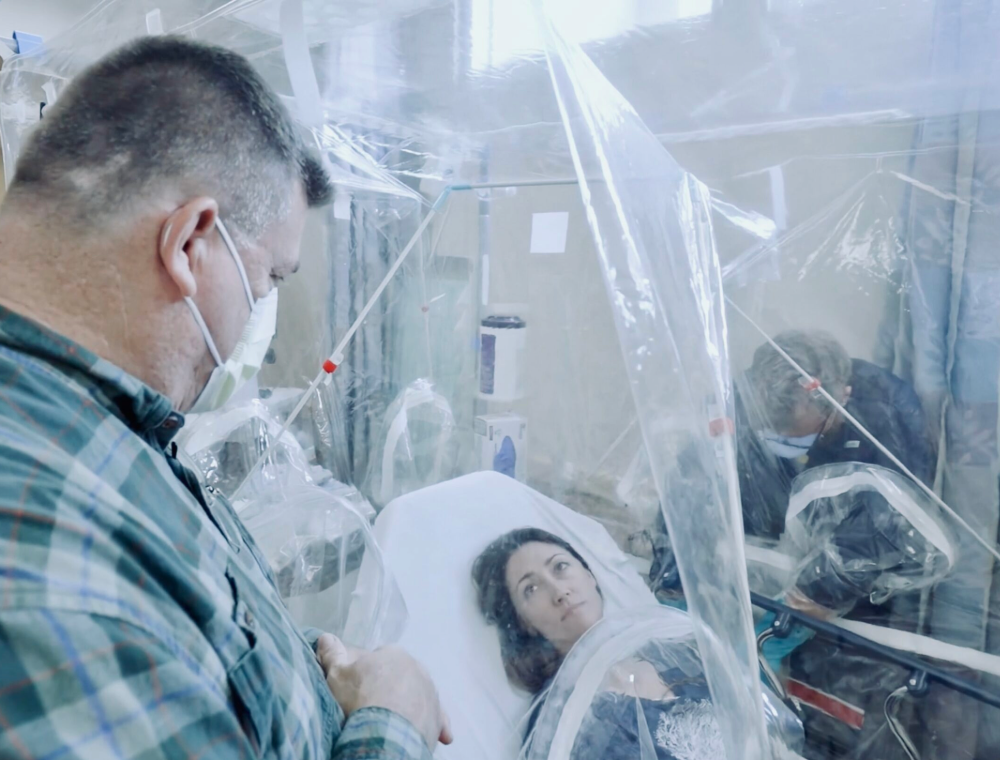
Our current paradigm of isolation care for patients with dangerous, transmissible infections creates multiple barriers that impede safe containment of the patient (and their pathogen). It also can prevent providers from providing the highest-quality patient care.
Today’s accepted best practice involves an onerous combination of infrastructure, consumable supplies, and protocols applied across a spectrum of outdated transmission precaution formulas (“Droplet,” “Contact,” “Airborne,” etc). This approach invites inappropriate choices for isolation procedures and often contradicts a nuanced and modern understanding of pathogen transmission. More importantly, our current paradigm for patient isolation care is highly dependent on resources, personnel, and time to operate safely, all while simultaneously obstructing access to the bedside, which reduces time spent with patients.
Physical and temporal separation are inherent byproducts of present-day infection prevention and control (IPC) standards, and they adversely impact quality of patient care. Even the simplest IPC protocols—the commonly used “contact precautions,” for instance—require the added time and effort of donning (putting on) personal protective equipment (PPE) such as gowns and gloves, with proper disposal and hand hygiene following afterward.
Several studies have demonstrated that these actual and perceived barriers to patient access reduce the amount of time that staff spend at the bedside and result in worse patient outcomes. Barriers to bedside access increase when patients are put in airborne or respiratory isolation, dictating an airborne infection isolation room (AIIR), where they will be located behind a closed door and, generally, a certain physical distance from workstations.
Worldwide Impact
I have seen the negative impact of IPC on patient care in the hospital and in outbreak treatment units time and again. High-quality patient care becomes particularly challenging when adhering to isolation precautions for high-consequence infectious diseases (HCID), such as potential cases of viral hemorrhagic fevers like Ebola, Marburg and Lassa fevers.
In most instances in the United States, patients suspected of suffering from such conditions are ultimately diagnosed with a different disease, but during their imposed purgatory in isolation, we are slow to perform a comprehensive history and physical. It takes an extended amount of time to get the routine laboratory and radiographic data we need for effective care, and we don’t provide frequent assessment and intervention. During times of heightened Ebola virus outbreak awareness (e.g., during the 2014-2015 West Africa Ebola crisis), U.S. hospitals experienced deaths due to slow diagnosis and management of treatable diseases such as malaria.
A Logistical Conundrum
Easier to quantify compared to quality of patient care, the associated logistics and resource requirements of appropriate IPC are often a nightmare for health systems. Hospitals already consume a steady supply of gloves, gowns, masks and N95 respirators, all of which are a cost burden by themselves. In any period of outbreak or heightened vigilance, the cost of additional PPE can easily burn through hospital budgets and disrupt fragile, just-in-time supply chains, as most of us experienced during the early COVID-19 pandemic.
Adequate availability of AIIR spaces requires a large infrastructure investment, and the lack of sufficient negative-pressure isolation rooms in most small (and many large) hospitals creates significant risk. Waste management presents an additional challenge, particularly in the context of HCID. Few hospitals have the ability to manage highly hazardous infectious waste on their own, and the cost of contracted Category A waste removal is exorbitant.
Finally, our current IPC approach puts healthcare workers and hospital staff at risk. Despite the application of other controls, PPE constitutes the first and last line of defense against nosocomial transmission during direct patient care. And PPE is only as good as the skills of the user, who must appropriately complete the meticulous tasks of donning, using, and doffing the PPE.
The level of skill required to manage hazardous or high-consequence infections necessitates high-quality training and frequent refreshment. Our own biocontainment unit team conducts intensive multi-hour training on a quarterly basis for maintenance of these skills. PPE’s dependence on appropriate human action makes it an unreliable hazard control. Attesting to this fact are multiple studies identifying healthcare workers as among the highest-risk occupations for being infected with COVID-19.
A New Concept for Isolation
The Carecube Isolation System for Treatment and Agile Response for Infectious Diseases (ISTARI) concept was developed specifically to counteract these problems and liberate patients and providers from the tyranny of separation. With the Carecube ISTARI, we intentionally worked to turn IPC practice on its head and create a new paradigm, building infrastructure, protocol, supplies and skills into a single flexible device. The Carecube provides safe isolation from pathogens (including airborne transmission) without the need for costly brick-and-mortar construction. With built-in patient interfaces, it allows direct patient care without a reliance on the PPE supply chain or staff proficiency in appropriately donning and doffing of PPE. The Carecube device also limits the waste generated by the constant cycle of donning and doffing.
Most importantly, from our perspective, the Carecube eliminates the separation between caregiver and patient. Immediate access and unlimited dwell-time at the bedside allow for constant monitoring and timely intervention. Eliminating the required time and effort for donning and doffing lets healthcare workers be more efficient, providing care to more patients in the same space of time. Patients can feel supported by and connected to their healthcare provider—as a real person, not simply a pair of eyes behind a plastic shield. Patients also have a closer connection with family and loved ones who are able to visit in person and without risk.
The Carecubes ISTARI was born out of two decades of work in biocontainment and a constant stream of “I wish…” My wish now is that we can share this amazing technology widely, so that healthcare workers and patients across the globe can benefit from better, safer and more compassionate care.