Omaha World Herald Covers Carecubes Series A
By Julie Anderson – Medical Reporter, Omaha World-Herald

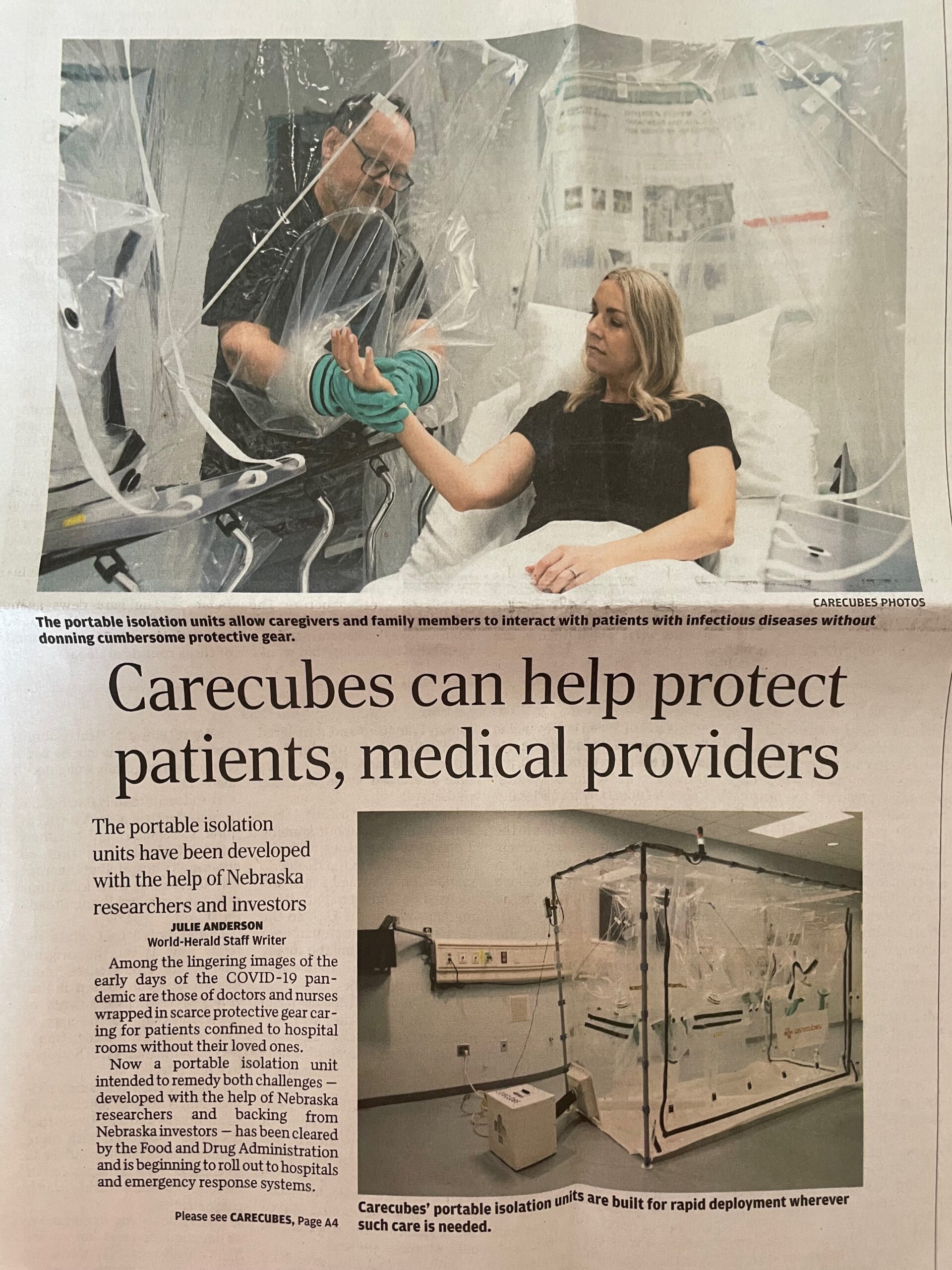
Editor’s Note: The following has been reposted with permission from the Omaha World-Herald, who covered the news of the Carecubes’ Series A. Click here to read the story.
Among the lingering images of the early days of the COVID-19 pandemic are those of doctors and nurses wrapped in scarce protective gear caring for patients confined to hospital rooms without their loved ones.
Now a portable isolation unit intended to remedy both challenges — developed with the help of Nebraska researchers and backing from Nebraska investors — has been cleared by the Food and Drug Administration and is beginning to roll out to hospitals and emergency response systems.
The units, marketed under the name Carecube ISTARI, essentially are negative air pressure tents that can can be quickly deployed to enclose infectious patients — and pathogens.
The air inside is filtered in order to meet hospital requirements for airborne infection isolation rooms, and the devices feature clear, flexible plastic walls with portals that allow providers, even family members, to interact with patients without donning protective gear.
Alex Laskey, CEO of Carecubes, the company that makes the Carecube, said the idea behind the device was to reinvent PPE by wrapping it around the patient, freeing providers to take care of them.
Traditional PPE, in addition to being hot and uncomfortable, typically can only be used once before being discarded, creating a lot of waste. And there’s the risk of contact with pathogens that comes with donning and doffing the gear, particularly when it comes to the most dangerous ones.
“We don’t have to sacrifice provider safety for patient dignity, and we don’t have to sacrifice patient care to protect everyone else,” said Laskey, whose only sibling is a physician in a hospital near Seattle.
Carecubes announced Thursday that it closed a new $6.5 million round of funding with backing from leaders in health care and the public sector.
The devices now are in hospitals, clinics and emergency response systems in more than 36 communities across 13 states and territories, including Bellevue Hospital of NYC Health+Hospitals, Providence Sacred Heart Medical Center and the Metro Health & Medical Preparedness Coalition of Minnesota.
Development of what became the Carecube initially was funded during a challenge by the Defense Advanced Research Projects Agency. Laskey is a longtime collaborator of developer Saul Griffith, founder of the San Francisco-based engineering firm Otherlab.
Some testing was done on an isolation tent device during the West Africa Ebola epidemic in 2014 to 2016. That device, however, didn’t make it into development.
Dr. James Lawler, however, had become aware of the device. He and his fellow researchers at the University of Nebraska Medical Center’s Global Center for Health Security were looking for ways to better respond to outbreaks in the face of limited resources, supply chains and training, not just in places like West Africa but also in rural hospitals in the United States.
Just before the COVID pandemic broke out, the researchers received a grant from the federal Centers for Disease Control and Prevention to strengthen infection control training, education and tools. The program was targeted to small, rural hospitals across the country that face some of the most persistent challenges in infection prevention and control. The developers also have received support from the Administration for Strategic Preparedness and Response.
Dr. Jana Broadhurst, director of UNMC’s emerging pathogens laboratory and the principal investigator on the project, said even the U.S. doesn’t have enough airborne isolation rooms to meet a surge in demand from an airborne pathogen.
So the researchers traveled to San Francisco and partnered with Otherlab to develop new patient isolation care devices that addressed some of those challenges.
Laskey said Griffith then approached him about starting a company to partner with the doctors and bring the device to market. They formed a firm and focused on finding manufacturing capacity in the U.S. so the device could be manufactured domestically, making the supply chain more reliable in the event of future emergencies.
The FDA cleared the device in 2024. The devices now are manufactured in Minnesota. Key suppliers are located in North Carolina, Connecticut, California and Ohio.
Broadhurst said it’s been rewarding to get to a point of being able to finally field a device that can address some of the problems the researchers have been wanting to tackle for years.
“This is an important step to see it finally being used in real clinical work,” she said.
She noted that the researchers plan to continue to gather data as the device rolls out to learn more about how to improve it for use in different settings.
“We’re going to learn about more ways that this can be useful than we originally imagined,” she said.
The idea ultimately is to be able to manufacture a device that is durable, scalable and becomes more affordable over time so community hospitals at the front line of dealing with infectious diseases can adopt them, Broadhurst said.
Lawler noted that while the focus now is on the original device, there are three more in development behind it that emerged from assessments of vulnerable points in the chain of care, including the need to transport patients from small hospitals to larger ones.
Laskey said the company’s ultimate aim is to make the Carecube so affordable and easy to use that it can be used even with more ordinary infections like influenza to eliminate the transmission of infectious diseases inside health care settings.
“We’re not going to eliminate all infectious diseases, but we can dramatically reduce its transmission and care for people,” he said.
Subscribe to receive additional insights delivered to your inbox.