How County-Level Health Departments in California Blend Emergency Preparedness with Everyday Patient Care

California enters this summer facing a number of simultaneous pressures:
- Preparation for the increasing likelihood of measles-presenting patients
- An influx of international travelers for the FIFA World Cup and for the busy travel season
- A measles-driven mandate to fortify infectious disease treatment capacity
- Determination of what tools best equip frontline providers to protect themselves while caring for patients
What’s impressive is how, despite these challenges, California’s public health leaders have responded. The state’s forward-thinking leaders are rethinking not just emergency preparedness, but how the same tools we use in life-or-death situations, when every second counts to prevent the spread of disease, can also be deployed in everyday workflows.
Let’s look at some of the innovative solutions they’re coming up with at the county level in California.
Alerts in Sacramento County
In February 2026, the California Department of Public Health (CDPH) issued a measles advisory for Sacramento County after multiple travel-related cases were confirmed.
According to the alert, “Direct importations of measles by international travelers and from areas of the United States experiencing large measles outbreaks are expected to continue.”
With the public anxious to move on from the specter of COVID, it’s easy to forget how quickly airborne diseases can spread in clinical settings. California public health officials have urged providers to mask symptomatic patients immediately, bypass waiting rooms and move them into isolation units as soon as possible.
One month after the measles advisory, the CDPH sent out another press release, this time urging Californians to get vaccinated against measles after more cases were reported in Placer and Sacramento counties. They also recommended unvaccinated individuals exposed to measles stay at home and call their healthcare provider for guidance on testing and care.
Continued Community Education in LA County
In May 2026, County of Los Angeles Public Health shared a press release confirming a case of measles from a resident who had recently traveled. In collaboration with the Centers for Disease Control and Prevention (CDC), LA county investigated communicable disease exposures on international flights to the United States.
They shared that the most effective way to protect oneself and their family from measles is the measles-mumps-rubella (MMR) vaccine. They encouraged residents to confirm their immunity and get vaccinated if needed, especially before traveling, as these simple steps help protect the entire community.
California Trauma Centers at the Front Line
While county health departments are doing the heavy lifting with surveillance, vaccination outreach and community alerts and education, California’s Level I and Level II trauma centers are also playing a critical role in the state’s preparedness strategy.
These facilities are often the first places where measles-presenting patients or symptomatic travelers walk through the door. And during a summer with plenty of global movement, thanks to the FIFA World Cup combined with the typical increase in travel during June, July and August, that exposure risk increases drastically.
The state has reminded providers to follow these best practices to minimize the risk of infectious disease spread:
- Reinforce rapid airborne-isolation workflows to ensure symptomatic patients are isolated immediately
- Bypass traditional triage bottlenecks and reroute high-risk patients directly into controlled environments
- Re-train staff on PPE use and airborne precautions, especially in high-volume emergency departments (EDs)
- Coordination with county health departments for real-time reporting and tracing
These are just a few essential steps in preventing disease transmission during busy seasons. California expects millions of visitors to move through airports, theme parks and major sporting events like the FIFA World Cup and the kickoff of the NFL season, and counties should prepare now for what’s to come.
The 2026 State of Public Health Report
The CDPH makes one thing clear: California is not approaching preparedness as a seasonal project. It’s treating it as a year‑round, system‑wide responsibility that blends emergency response with the realities of everyday care.
California’s 2026 State of Public Health report highlights several themes that are especially relevant as counties prepare for measles, HCIDs and a summer of heavy international travel.
The CDPH emphasizes the need for flexible, scalable infrastructure to respond to outbreaks, natural disasters and emerging threats without disrupting routine care.
The report also emphasizes the importance of tools and workflows that support both emergency response and day‑to‑day operations. California has prioritized investments in solutions that improve patient flow, protect staff and enhance safety whether the threat is measles, wildfires or busy shifts in EDs.
These themes have been emphasized alongside other factors that demonstrate true leadership on the state, national and even global stage:
- Strategic management of the effects of federal and local budget cuts
- Vaccine education
- Coordination with global health organizations
- State-to-state alliances with other U.S. states
- And more
Taken together, it paints a picture of a state that understands the stakes and is proactively building the infrastructure to meet its goals.
How Carecubes is Strengthening California’s Preparedness
From Sacramento to Los Angeles, counties are already integrating the Carecube into their preparedness plans and using the deployable negative‑pressure unit to strengthen both emergency response and everyday care.
The map below shows where Carecubes are already in place across the state.
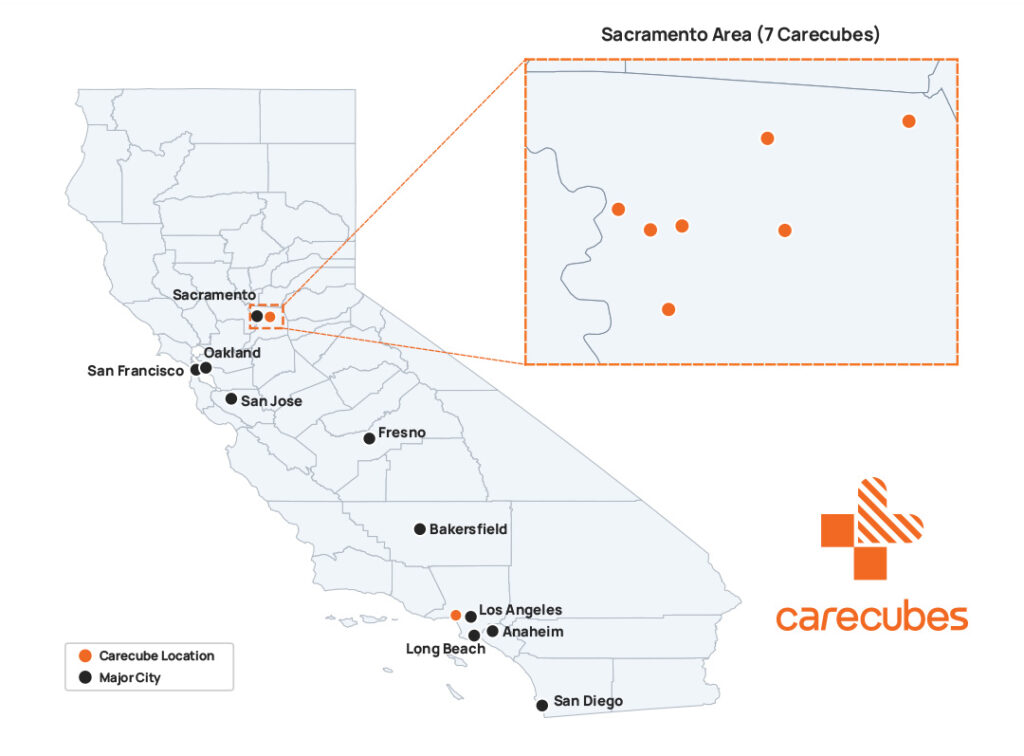
Not every county has the infrastructure, budget or physical space to expand permanent airborne‑infection isolation rooms, but that’s where deployable solutions like the Carecube become essential.
For counties that haven’t yet adopted the Carecube, here are just a few examples of how it can be used:
- A flexible, mobile isolation capability that can be deployed in triage, hallways, surge tents or other hospital settings.
- An emergency‑response asset and an everyday workflow tool, especially during flu season
- Part of a county’s broader prevention strategy
As California heads into a summer defined by global travel and airborne‑disease risk, the biggest question is: Is your county ready?
Many already are. And for those still exploring options, now is the time to learn what’s possible.
To learn more about how the Carecube can support your community, reach out today!