Washington Business Journal Covers Carecubes Series A
By Sara Gilgore – Staff Reporter, Washington Business Journal

Editor’s Note: The following has been reposted with permission from the Washington Business Journal. Click here to read the story.
Alex Laskey isn’t a doctor. But he wants to help them better treat their infected patients — and protect them from getting sick, too.
The co-founder and former president of Arlington’s Opower Inc. is now working to grow Carecubes, a health care startup also headquartered in Arlington that aims to eliminate the spread of infectious diseases ranging from measles to flu to tuberculosis to Ebola.
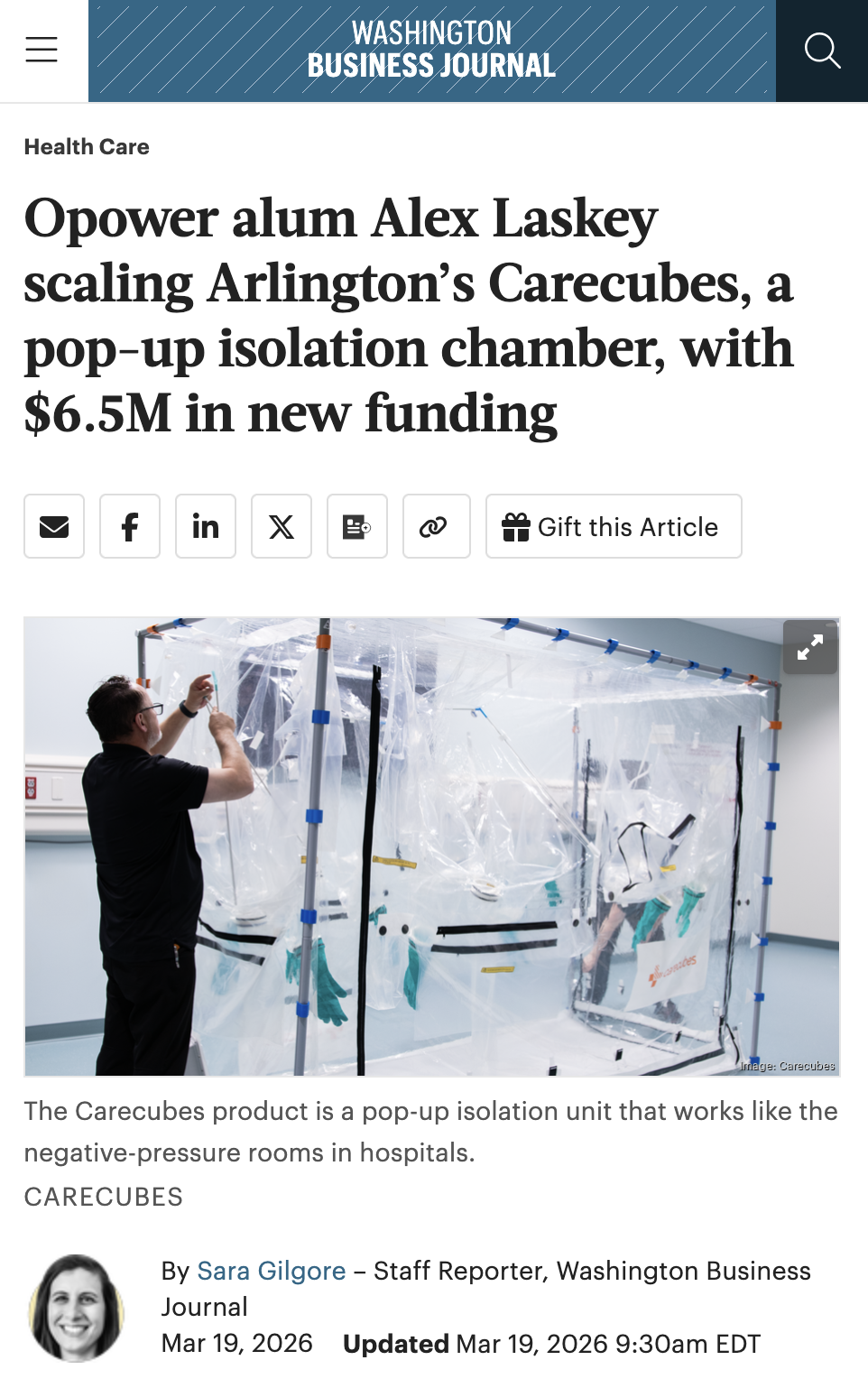
Its product: a pop-up isolation unit, dubbed the Carecube, that works like negative-pressure rooms in hospitals to contain airborne germs. The units can be set up in about 15 minutes around a contagious patient, giving health systems more bandwidth to provide good care and cutting down on the costs to do it.
Carecubes is now working to build up its customer base of hospitals, already with dozens across 13 states, according to Laskey, its founder and CEO. And $6.5 million in fresh financing should help.
The company is using that Series A funding to help expand its Minnesota-based manufacturing and ensure it has the inventory to meet demand, Laskey said. It’s also putting those dollars toward product improvements and new hires across operations, product delivery, marketing and sales.
The company has seven full-time employees and more part-time staff, with plans to hire a few more people this year, plus contractors and consultants, he said.
The business, founded in summer 2020, secured the latest capital from a big-name investor contingent including Oscar Health CEO Mark Bertolini, former Medtronic CEO Bill Hawkins, former USAID Administrator Henrietta Fore and investor Betsy Cohen, as well as Boston’s Schooner Capital, San Francisco’s Lifeforce Capital and Omaha’s CQuence Health.
The round follows a $2.6 million seed raise, as well as about $4 million in grants from government agencies, and corporate and private foundations.
The Carecubes product landed Food and Drug Administration clearance in 2024 as a tool for hospitals and governments to prepare for outbreaks. So far, its customer roster includes the Maryland Hospital Association locally, as well as hospital systems across the country, and state and county governments.
Leading Carecubes might seem like an odd move for Laskey, a local energy industry veteran who helped shepherd Opower through its initial public offering in 2014 and sale to Oracle two years later.
But the pandemic made it an easy decision, he said.
He remembers the impact to his brother, a Seattle-area psychiatrist whose hospital had some of the first known Covid cases in early 2020 — and who cared for his colleagues as they suffered from the mental health effects of that frontline work.
And he points to the lessons from the crisis, as people died from the virus, hospitals shut down services to prevent transmission and patients delayed care on other conditions that later worsened — all of which could be mitigated with isolation if it were more often feasible. Even on a good day with no public health emergency, hospital-acquired infections are a leading cause of death in the U.S.
“What we’re attempting to do is to replace or supplement brick and mortar isolation rooms that exist in hospitals, but don’t exist in nearly enough numbers and don’t exist equitably across our health system,” he said.
The company is also looking to supplement personal protective equipment, which can take several minutes to put on and take off, often hindering care for isolated patients.
Carecubes was conceived through research at the University of Nebraska Medical Center, with funding from the Arlington-based Defense Advanced Research Projects Agency. The Centers for Disease Control and Prevention, and the Administration for Strategic Preparedness and Response, also supported its development.
Laskey was working with Saul Griffith, who’d invented the original Carecubes prototype, to launch in 2020 what’s now Rewiring America, a nonprofit designed to help people reduce their energy bills. Laskey was then tapped to help translate the product into a business.
“There wouldn’t have been the urgency to do it were it not for the pandemic,” he said, “and I wouldn’t have been compelled to spend my time on it were it not for seeing millions of people getting sick, and doctors and nurses getting treated so poorly, and getting sick and dying.”
Long term, Laskey envisions products like the Carecube becoming as ubiquitous as automated external defibrillators, or AEDs, that are now found in schools, airports, malls, office buildings and other high-traffic areas.
“My feeling is, eventually, deployable isolation capacity should be something that exists everywhere,” he said, “and that all different kinds of institutions that have a responsibility for housing and caring for people should have the ability to very affordably, very easily isolate somebody who ends up being infectious.”
Subscribe to receive additional insights delivered to your inbox.